

Tinoco, K., Sasaki, S., Alvarez, J., Rabit, J.
Media has always had a major role in today’s generation, it’s in which we give our thoughts out to, where we post pictures of ourselves or for others. Our professor asked us to go interview a historian or a person who has a knack for history. Here, we interviewed Mr. Sabas S. Sambo, an elementary teacher from Holy Child Catholic School (HCCS).

Photo taken after interview
Here is the full transcription of our interview.
J: Who is the most influential person, in terms of media, do you think changed history?
Mr. S: One of the most influential person that I know, in terms of media, is Cardinal Sin or Jaime Cardinal Sin. Why? It is because he influenced people to fight in a manner that is quiet and have a revolution that no blood poured out and I think that in his way of calling the Filipino people to revolt against the government (President Marcos), he is one of the most influential person that I know.
J: Question number two, how did media evolve throughout Philippine History up until the present?
Mr. S: Probably media is the number one reason why they are here is to inform us about the latest happenings in our society so they are very influential, they can make or break the people, the society or the whole country because of their influence as a media or press.
J: Question number three, how was media considered as a weapon of mass destruction during the times of Martial Law?
Mr. S: The number one reason is that the press became the instrument for the Filipinos to fight and revolt against the reign of Marcos because they saw how Marcos held the country for 21 years that’s why they wanted change, and through that media, the people were influenced to fight for their freedom.
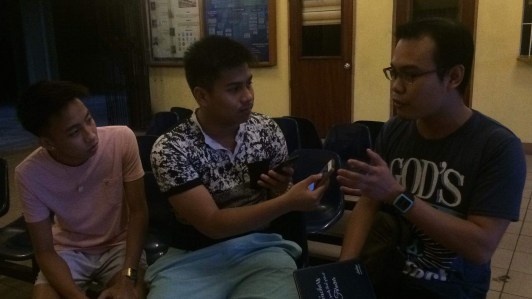
Photo taken during interview between Mr. Sambo and Alvarez
J: Question number four, how did freedom of speech become the mother of all liberties?
Mr. S: Here in my notes, as I was examining your questions a while ago, it became the mother of liberties (freedom of speech) because the people are taking the rights that are taken from them back, and because of that the press are becoming informed that that’s what they should have, that they should have their rights that are taken from them and they should fight to have it again.
J: Question number five, how does media perform during the times of Martial Law?
Mr. S: Because of media the confidence of the Filipinos returned, their belief that whatever happens as long as we are all united as one to fight for it. The people from the time of Marcos are encouraged to fight, they are continued to be informed and enlightened because of media, even before, Marcos said that all forms of media should stop but Filipinos are making ways to let themselves be informed about what’s happening.
S: Question number six, how does the press cope up during these times? (present times)
Mr. S: In terms of the press and media of today, I can say that there media that are bias. Why? Because they are after ratings, they only want higher ratings, they are (sometimes) self-centered forms of media, they are not being objective type of media because sometimes they want that the only good things of the government are covered not the bad side of it. They’re not being objective, and letting the truth come out.
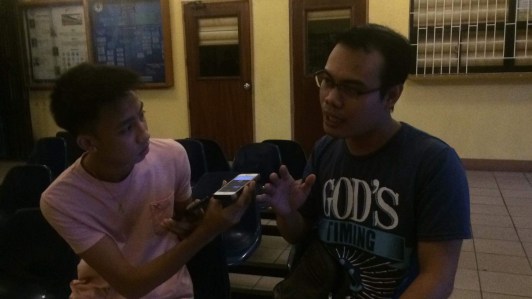
Photo taken during interview between Mr. Sambo and Sasaki
S: Question number seven, what can you say about the condition of the Philippines during these times? (Present Time)
Mr. S: While I can say that in our present time is very powerful, they are great influencers in terms of the youth of today especially dominating on the impact of the people because when the media talks, the people listen. They believe what the media says.
S: Question number eight, what are the media restrictions during the times of Marcos?
Mr. S: In times of Martial Law, number one restriction is you can’t put out news that are against Marcos, on his administration because when you put out news like that, they’re going to abduct and put you in jail without any Juris Diction, ‘cause in times of Marcos, Marcos declared Martial Law, the Wreath of Abdias Corpus was suspended, in which no investigations are needed to put you into jail because you are against the government, when you’re against the government you are already considered a threat.
S: Question number nine, what are the effects of these restrictions?
Mr. S: With those restrictions, the Filipinos became more enthusiastic and because of those restrictions during the time of Martial Law, the Filipinos became more enthusiastic because they wanted freedom, they wanted to be free of Marcos’ administration that’s why they went to EDSA to start the revolution or the so called, People Power Revolution.
S: Last question, have you experienced these things first hand? In which media or freedom of speech was not an option?
Mr. S: I haven’t experienced this, but I can say that if you’re after your own selfishness and not for the good of the countrymen that’s the time that media is not an option because you’re not after the common good but for your own self.
End of transcription.
As we read through the conversation between our interviewers and the respondent, we are sure that media has had its ups and downs throughout the Philippine history, blood has been shed, papers not revealed but no matter how much the government restricts the use of media, especially during the time of Marcos, Filipinos will continue to fight back and take the rights of freedom of speech. We are thankful for the media we encounter in the present because at an early age we are already bombarded with news that we should tackle since we are the future of our countrymen. Just like what Jose Rizal has said, “Ang kabataan ang pag-asa ng bayan” and we have to prove that our national hero was right.
 Acta Diurna